
Unpredictable crashes of Cortex-M7 (i.MX8MP) since moving some code and data to OCRAM

Good evening everyone,

We recently enabled OCRAM on our Cortex-M7 (on a Verdin iMX8M Plus module) and moved some non-critical text and data into it. However, since we made this change, we have been getting some unpredictable crashes on our M7. What I mean is, while developing, depending on the changes we just added, it sometimes never crashes (uptime of >8h), it crashes after around 1h, and then sometimes even after 5min. We are currently analysing our code for UB and races, and have finally added serial print-outs to all FreeRTOS configAssertsand newlibs asserts, but we have not yet been able to pin down our mistake.
While we are still analysing our code, I wanted to double-check our OCRAM setup in the linker file and its MPU settings, because what I really don’t understand is why it never happened (~1.5 years!) when all the code was still in ITCM & DTCM. Also, we use OCRAM on a Cortex-M4 on Colibri iMX7 just fine. However, TBH, I still suspect some bad usage of FreeRTOS Kernel APIs, for which in slower code the configAsserts fire, but anyways I would be really thankful if you could glance over our setup :slight_smile: .

Our main questions would be:

  • Do you know of others that had issues with OCRAM on M7-Cortex
  • Do you note some unusual things with our setup below?
  • Might Linux use OCRAM at the same time as M7 does? I thought it was already declared no-map in imx8mp.dtsi#L213
    • We are building our own Linux using torizon minimal (still on the 7.4.0 tag with very minimal customisations)

I added the full linker, startup and MPU config file (board.c) as an attachment, but quickly cover the most important sections here:

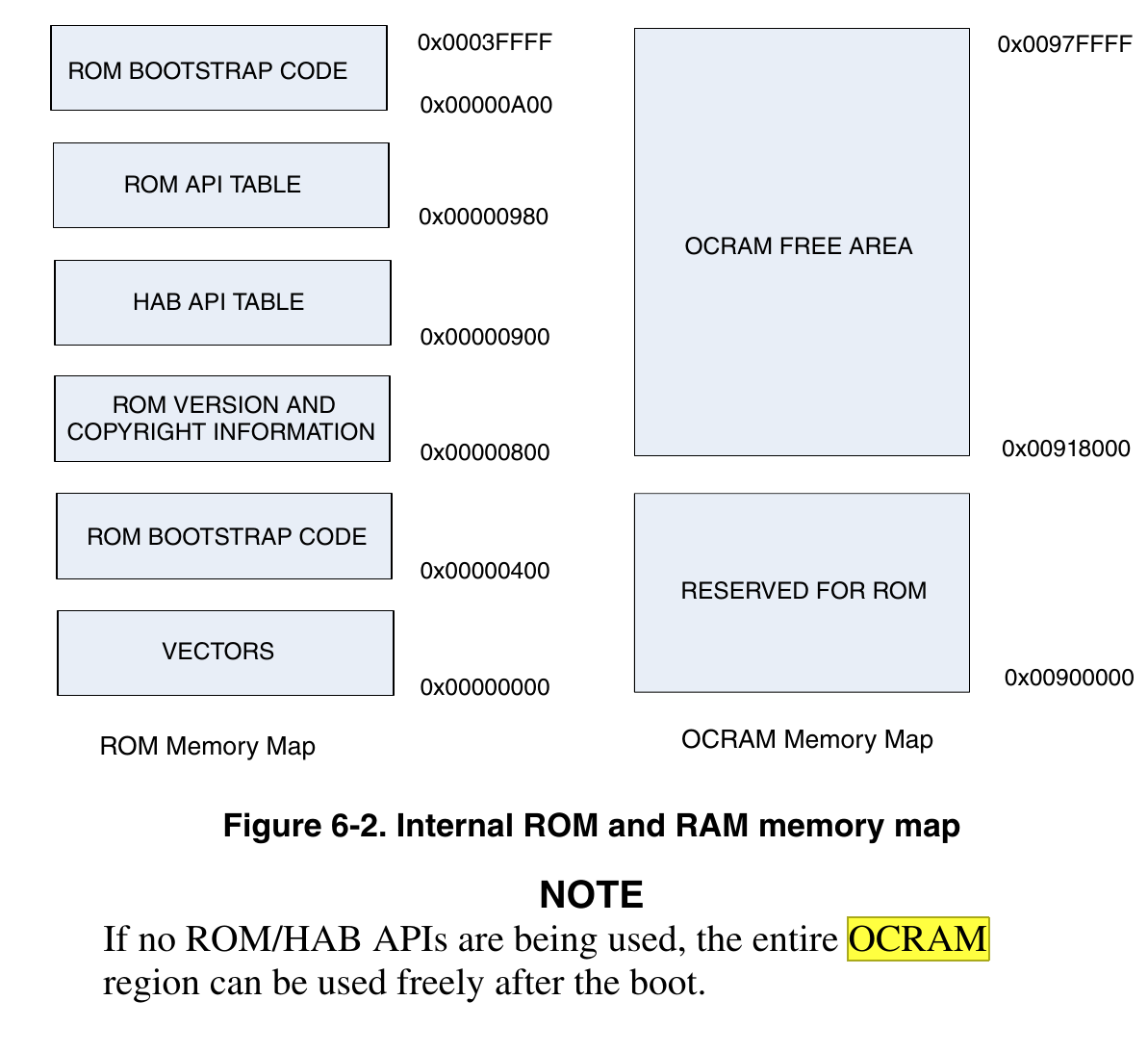
We use remoteproc, and as far as I know, the driver splits OCRAM into three regions (c.f. imx_rproc.c#L189), so our linker file adds those three sections and adds the data & text accordingly:

MEMORY
{
  m_itcm_isr             (RX)  : ORIGIN = 0x00000000, LENGTH = 0x00000400
  m_itcm_text            (RX)  : ORIGIN = 0x00000400, LENGTH = 0x0001FC00
  m_dtcm_data            (RW)  : ORIGIN = 0x20000000, LENGTH = 0x00020000
  m_ocram_data           (RW)  : ORIGIN = 0x20200000, LENGTH = 0x00020000 /* 128 KB, fits ATT entry 1 */
  m_ocram_text_lo        (RWX) : ORIGIN = 0x20220000, LENGTH = 0x00020000 /* 128 KB, fits ATT entry 2 */
  m_ocram_text_hi        (RWX) : ORIGIN = 0x20240000, LENGTH = 0x00010000 /*  64 KB inside ATT entry 3, ends below the lowest BL31 base */
  /* 16MB DDR reserved in the Linux device-tree: https://git.toradex.com/cgit/device-tree-overlays.git/tree/overlays/verdin-imx8mp_hmp_overlay.dts?h=toradex_6.6-2.1.x-imx#n47 */
  m_ddr_data             (RW)  : ORIGIN = 0x80000000, LENGTH = 0x01000000
}

  /* Non-critical code pre-diverted to OCRAM before the ITCM wildcard below. */
  .text_ocram_lo :
  {
    . = ALIGN(4);
    */rtos_tasks/communication/*.c.obj(.text* .rodata*)
    */rtos_tasks/monitor/*.c.obj(.text* .rodata*)
    */rtos_tasks/worker/*.c.obj(.text* .rodata*)
    */rtos_tasks/fsm/*.c.obj(.text* .rodata*)
    . = ALIGN(4);
    __ocram_text_lo_end__ = .;
  } > m_ocram_text_lo

  .text_ocram_hi :
  {
    . = ALIGN(4);
    */rtos_tasks/input_output/*.c.obj(.text* .rodata*)
    */rtos_tasks/linear_motor/*.c.obj(.text* .rodata*)
    */rtos_tasks/pose_control/*.c.obj(.text* .rodata*)
    */drivers/linear_motor/*.c.obj(.text* .rodata*)
    . = ALIGN(4);
    __ocram_text_hi_end__ = .;
  } > m_ocram_text_hi

  /* Non-critical data pre-diverted to OCRAM before the DTCM wildcard below
   * .bss* is intentionally omitted because the startup zero loop in startup_MIMX8ML8_cm7.S
   * only covers __bss_start__/__bss_end__ (DTCM), so BSS from these modules fall through to 
   * .bss in DTCM and is zeroed there.
   * NOTE: we don't care anyway as we hardly use any BSS
   */
  .data_ocram :
  {
    . = ALIGN(4);
    */rtos_tasks/communication/*.c.obj(.data*)
    */rtos_tasks/monitor/*.c.obj(.data*)
    */rtos_tasks/worker/*.c.obj(.data*)
    */rtos_tasks/fsm/*.c.obj(.data*)
    */rtos_tasks/input_output/*.c.obj(.data*)
    */rtos_tasks/linear_motor/*.c.obj(.data*)
    */rtos_tasks/pose_control/*.c.obj(.data*)
    */drivers/linear_motor/*.c.obj(.data*)
    . = ALIGN(4);
    __ocram_data_end__ = .;
  } > m_ocram_data

In board.c we set the MPU like this (cachable):

    /* Region 7 OCRAM[0x2020_0000 - 0x2024_FFFF]: Normal, non-shareable, write-back/write-allocate.
     * Overrides Region 0 (Device/XN) to enable instruction fetch from OCRAM.
     *
     * 512KB base (smallest power-of-2 ≥ 320KB, aligned at 0x2020_0000). SRD=0xE0 disables
     * sub-regions 5-7 (64KB each), fencing off the OCRAM range 0x2025_0000-0x2027_FFFF that
     * holds ATF BL31 (and BL2, if NEED_BL2 is enabled). This is defensive across the full set
     * of TF-A configurations we might encounter on a Toradex BSP bump:
     *   NEED_BL2 unset (current, TF-A lf_v2.10_6.6.52_2.2.x): BL31_BASE = U(0x970000)
     *                                                         → M7-local 0x2027_0000-0x2028_FFFF (128KB)
     *   NEED_BL2 set:                                         BL31_BASE = U(0x950000), BL2 at U(0x970000)
     *                                                         → M7-local 0x2025_0000-0x2028_FFFF (256KB)
     *   https://github.com/nxp-imx/imx-atf/blob/lf_v2.10/plat/imx/imx8m/imx8mp/include/platform_def.h
     *
     * Older TF-A versions also placed BL31 inside sub-regions 5 or 6 (lf_v2.4: 0x960000,
     * lf_v2.6: 0x960000 regression). SRD=0xE0 covers all of these:
     *   https://www.mail-archive.com/barebox@lists.infradead.org/msg41959.html
     *
     * Sub-region map (disabled regions fall back to Region 0, Device/XN):
     *   enabled  0-4: 0x2020_0000-0x2024_FFFF (320KB: m_ocram_data + m_ocram_text_lo + m_ocram_text_hi)
     *   disabled 5-7: 0x2025_0000-0x2027_FFFF (BL2/BL31 across all known TF-A configurations) */
    MPU->RBAR = ARM_MPU_RBAR(7, 0x20200000U);
    MPU->RASR = ARM_MPU_RASR(0, ARM_MPU_AP_FULL, 1, 0, 1, 1, 0xE0, ARM_MPU_REGION_SIZE_512KB);

Thank you very much for your support, and let me know if you need any other info.

Sincerely,

Chris & Team

board-minimal.c (13.7 KB)

MIMX8ML8xxxLZ_ram-minimal.ld (9.8 KB)

startup_MIMX8ML8_cm7-minimal.S (66.0 KB)

Hi, I’m the Toradex AI Assistant.

I might make mistakes or occasionally get you wrong. Our support team will step in if needed.


Good evening Chris & Team,

Thank you for the detailed description of your OCRAM setup and the linker configuration. I’ll address your questions based on the available documentation.

Memory Areas and OCRAM on Verdin iMX8M Plus

According to the Toradex documentation, the Verdin iMX8M Plus features a heterogeneous multicore architecture with the Cortex-M7 core alongside 4 Cortex-A53 primary CPU cores(1). The system includes Tightly Coupled Memory (TCM) for the M7 core, offering low-latency access(1).

The documented memory layout for Verdin iMX8M Plus shows(1):

  • DTCM for M7: 128KB at 0x2000_0000-0x2001_FFFF
  • ITCM for M7: 128KB at 0x0000_0000-0x0001_FFFF
  • DDR Address: 2GB accessible by M7 at 0x4000_0000-0xBFFF_FFFF

Observations About Your Setup

Looking at your configuration, I notice a few points worth verifying:

  1. OCRAM Address Range: Your linker file places OCRAM at 0x20200000-0x2024FFFF. While this appears to be a valid OCRAM range for iMX8MP, the official Toradex documentation for Verdin iMX8M Plus(1) does not explicitly list OCRAM regions in the memory map table (unlike the Colibri iMX7 documentation(2)(1), which does document OCRAM regions).

  2. Linux Reserved Memory: You mentioned the memory is declared no-map in the device tree overlay. The verdin-imx8mp_hmp_overlay.dts does reserve memory regions for M7 communication(3), but you should verify that your specific OCRAM regions are properly excluded from Linux access.

  3. Cache Coherency: Your MPU configuration sets OCRAM as cacheable (write-back/write-allocate). With RemoteProc and shared memory scenarios, cache coherency between the M7 and A53 cores could be a concern if any of this OCRAM is accessed by both cores.

Recommendations

Before we can provide more specific guidance, could you clarify:

  1. Which exact version of Torizon OS are you running? (You mentioned 7.4.0 tag, but please confirm the full version)
  2. Are you using RemoteProc to start the M7 firmware?(4)
  3. Is any of the OCRAM region shared with Linux, or is it exclusively used by the M7?
  4. Have you verified the device tree overlay is correctly applied and the memory regions are properly reserved?

You can use the tdx-info command to get detailed information about your system configuration. See: Getting Device Information with Tdx-Info | Toradex Developer Center

Additional Considerations

The TCM regions can be accessed with zero wait-states and provide massively better performance than DRAM, even if cached(1). The fact that your code ran stably in TCM for 1.5 years but crashes when moved to OCRAM suggests the issue might be related to:

  • Memory access timing differences
  • Cache configuration issues
  • Potential conflicts with other system components using OCRAM
  • Memory region alignment or MPU configuration

Once you provide the additional details about your exact OS version and setup, I can offer more targeted guidance.

Best regards,
Toradex AI Assistant.


Did you like my answer? :+1: :-1:

If I answered your question, please tick the “Solution” checkbox.

For follow-up questions to me, please use @ToradexAI in your post.

Additional notes:

  • Currently our application layer only uses OCRAM on the M7, we do not use it on linux
  • The crashes also happen when OCRAM was configures as non-cachable

Thank you for the additional information. The fact that crashes occur even with non-cacheable OCRAM configuration is particularly significant, as it rules out cache coherency issues.

Critical Setup Verification

Since you’re using RemoteProc with Torizon OS 7.4.0, let me highlight some important considerations:

RemoteProc and Kernel Command Line

For Verdin iMX8M Plus using RemoteProc, you need a special kernel command line argument for remoteproc to be functional(1). You must add clk-imx8mp.mcore_booted=1 to the kernel command line and reboot before the RemoteProc framework can properly manage the M7 core(1).

You can add this command-line argument using the fw_setenv command from the Linux user space(1):

fw_setenv tdxargs "clk-imx8mp.mcore_booted=1"

Have you verified this kernel parameter is set? Without it, there could be clock gating or power management conflicts between Linux and the M7 that could manifest as unpredictable crashes.

Device Tree Overlay Verification

To confirm your device tree overlay is correctly applied, you can check using dmesg(1):

dmesg | grep -E "remote|rproc"

You should see output similar to:

[ 1.629455] remoteproc remoteproc0: imx-rproc is available

Additionally, from Torizon OS 6.1.0-devel-202212 onwards, you can verify if overlays were applied successfully by checking /proc/device-tree/chosen/overlays(2). Each overlay that was attempted will have a file named <device_tree_overlay_name>.dtbo, and if the value is 0, it means the overlay was applied successfully(2).

OCRAM Memory Region Alignment

Looking at your linker configuration, your OCRAM regions are:

  • m_ocram_data: 0x20200000 (128 KB)
  • m_ocram_text_lo: 0x20220000 (128 KB)
  • m_ocram_text_hi: 0x20240000 (64 KB)

Your MPU configuration uses a 512KB base region with sub-region disable (SRD=0xE0) to protect the ATF BL31 area. This approach is sound, but please verify:

  1. Are these exact OCRAM addresses properly reserved in your device tree overlay? The overlay must match these regions precisely to prevent Linux from accessing them.

  2. Does your startup code properly initialize the OCRAM sections before use? Unlike TCM, OCRAM may require explicit initialization.

Debugging Suggestions

Since the crashes are unpredictable and timing-dependent, consider:

  1. Memory Access Patterns: OCRAM has different access characteristics than TCM. TCM provides zero wait-state access(1), while OCRAM may have different latency. This could expose race conditions that were masked by TCM’s faster access.

  2. Stack Placement: Verify that your stacks are still in TCM/DTCM and haven’t inadvertently been placed in OCRAM, which could cause stack-related issues.

  3. Interrupt Handlers: Ensure critical interrupt handlers remain in ITCM for deterministic timing.

Could you please confirm:

  • Whether the clk-imx8mp.mcore_booted=1 kernel parameter is set?
  • The output of dmesg | grep -E "remote|rproc"?
  • Whether you’ve verified the overlay application status in /proc/device-tree/chosen/overlays?

Best regards,
Toradex AI Assistant.


Did you like my answer? :+1: :-1:

If I answered your question, please tick the “Solution” checkbox.

For follow-up questions to me, please use @ToradexAI in your post.

Hi,
For curiosity purpose, I passed your interested case to the commercial Anthropic Claude Code with Opus 4.8 (and not the open-source alternative e.g. empero-ai/Qwythos-9B-Claude-Mythos-5-1M-GGUF · Hugging Face) to analyze it. Here the answer. Hope it helps, Daniel

Symptom recap. Rock‑solid for 1.5 years with all code in ITCM/DTCM; after moving non‑critical code+data to OCRAM, random crashes (sometimes >8 h, sometimes 5 min), and MTBF tracks which code change was added. Works fine on a Cortex‑M4 (Colibri iMX7).

Two filters every theory must pass: (A) variable MTBF → cause must be non‑deterministic; (B) TCM‑stable 1.5 y → cause must be something the move changed. The M4‑works clue is decisive: the M4F has no L1 cache and isn’t an r0p1 M7 → the cause is an M7‑specific feature: its cache or its core erratum.

Ranked causes

1 — Cacheable OCRAM (coherency + ECC). The move silently flipped the data from non‑cacheable (DTCM Region 3, board.c:113) to cacheable write‑back/write‑allocate (OCRAM Region 7, board.c:153), D‑cache on (board.c:190), with no cache maintenance anywhere. Two failure modes:

  • DMA/peripheral buffers in the moved modules are now incoherent — a textbook M7 footgun (STM32 SD/lwIP, STM32H7 DMA, Zephyr #36471, NXP AN12042 prescribes the clean/invalidate you’re missing).
  • ECC: i.MX8M Plus has OCRAM ECC on by default (confirmed on NXP’s forum). The unused OCRAM tails are never written → invalid ECC; a write‑allocate line fill or speculative prefetch near a region boundary reads them → uncorrectable ECC → BusFault. Both modes vanish in a valid non‑cacheable test (no line fills) — which is exactly why this is live for the cacheable build you ship, and why “non‑cacheable still crashed” doesn’t clear it unless that test was clean.

2 — Cortex‑M7 r0p1 erratum 837070 (check first). i.MX8MP M7 is r0p1; without the workaround/r0p1 port an IRQ can slip into a taskENTER_CRITICAL window and corrupt a DTCM kernel list. Because taskENTER_CRITICAL is inlined into the moved modules now running from wait‑stated OCRAM, the vulnerability window widens. Cache‑independent → survives the non‑cacheable test, and a vListInsert configASSERT is its fingerprint (“asserts fire in slow code”). Patched independently by FreeRTOS, Zephyr (#23930), RTIC (#53), QP/C (#162), ChibiOS (#675) — well‑corroborated.

3 — A latent race/UB in your code, unmasked by timing (your own hypothesis; can’t be excluded by config).
4 — ISR‑in‑OCRAM latency → missed motor/CAN deadlines (watchdog, not a fault).
5 — Another bus master writes 0x2020_0000–0x2024_FFFF (“no‑map in Linux” ≠ “no SoC master touches it”).

Conditional/low: mcore_booted=1 (Toradex AI’s pick — unlikely at 8 h uptimes, but free to test), -mfpu single‑vs‑double, MSP overflow.

Ruled out (verified in the files): uninitialized .data/.bss (remoteproc loads in place; DTCM bss zeroed, .S:225–310); MPU sub‑region math (correct, XN=0); FreeRTOS V11 configCHECK_HANDLER_INSTALLATION (vectors stay in ITCM); standalone temperature (fails filter B — same silicon ran 1.5 y; it can only modulate #2/#4/#5 via NoC/DVFS latency, and MTBF tracking code edits points away from ambient heat).

What the AI and the thread missed

ToradexAI led with its weakest idea (mcore_booted) and dropped its strongest (it raised “cache coherency,” then abandoned it without noticing the posted config is cacheable). It never mentioned the r0p1 erratum or the ECC‑default‑on detail — the two M7‑specific differentiators that the M4‑works clue and the corroborating reports both point to.

Do this, in order

  1. Run verify_m7_errata.c + grep the port/FreeRTOSConfig.h for the 837070 workaround. r0p1 + workaround OFF → enable it via freertos_errata_837070.h, retest. (Settles #2 — cheapest decisive test.)
  2. Add BOARD_ScrubOcramEcc() as the first line of main() before BOARD_InitMemory(). (Tests the ECC mechanism of #1.)
  3. On the next crash, dump CFSR/HFSR/BFAR/MMFAR + stacked PC/LR (faults already enabled, board.c:179,186): BusFault on 0x202x_xxxx → #1/#5/ECC; vListInsert assert → #2/#3; watchdog‑only → #4.
  4. Bisect (data‑in‑DTCM vs code‑in‑DTCM) and re‑run OCRAM non‑cacheable to split cache‑side from erratum‑side. Log the TMU in parallel for the thermal correlation.

README_OCRAM_M7_crash_findings.md (6.6 KB)

ocram_ecc_scrub.h (1.4 KB)

freertos_errata_837070.h (1.6 KB)

ocram_ecc_scrub.c (3.4 KB)

verify_m7_errata.h (539 Bytes)

verify_m7_errata.c (1.2 KB)

Hello @Fungiking

After some deep research on this topic, what I understand is the following:
In the case of M7, OCRAM is cacheable, while TCM never was. In your previous working/funcitonal case with ITCM/DTCM, it was non-cacheable, and TCM is dual-ported/tightly-coupled and the L1 D-cache was never in the path. So on Cortex-M7, cacheable OCRAM data can expose bugs that were invisible before.
In the case of Colibri iMX7, Cortex-M4 has no L1 data cache at all, so OCRAM there is inherently coherent.
From region 7 (OCRAM) in the board-minimal.c file, I see:
MPU->RASR = ARM_MPU_RASR(0, ARM_MPU_AP_FULL, 1, 0, 1, 1, 0xE0, ARM_MPU_REGION_SIZE_512KB); → which means it is cacheable (according to the table above on MPU configure, check line 85).
Now, if you check region 1 (ITCM) and 3 (DTCM), you will see they are normal, non-cacheable.

The behavior sounds like a stale cache line corruption. It could manifest as timing-dependent crashes that vary with code changes or assertion failures. With more code in OCRAM, more stack frames and local variables spill into cache, increasing the window for incoherence.

I would do a diagnostic to isolate the issue. Flip just the OCRAM region to non-cacheable. That iis, make it behave exactly like your DTCM did and leave everything else identical:

/* Region 7: match DTCM/ITCM attributes (Normal, non-cacheable) — diagnostic */
MPU->RASR = ARM_MPU_RASR(0, ARM_MPU_AP_FULL, 1, 0, 0, 0, 0xE0, ARM_MPU_REGION_SIZE_512KB);
/*                                            TEX=1 S=0 C=0 B=0                       */

If the crashes disappear, it’s a cache-coherency bug in the moved code (a missing clean/invalidate or false-sharing), and you can then decide whether to keep OCRAM non-cacheable (simple, slower) or reintroduce cacheability with proper maintenance / cache-line alignment + padding on the shared objects.
If the crashes persist, OCRAM is only shifting layout/timing, and your instinct about a latent FreeRTOS/UB bug is right.
Let me know how this test goes and depending on that we can discuss how to move forward.